


 Entrepreneurship It is a dream that many ambitious young people or budding entrepreneurs have, as they seek to leave their mark on the business world and build startups that achieve success and financial freedom. However, this path is fraught with challenges and difficulties, especially in the early stages of the venture.
Beginner entrepreneurs often face critical situations that could lead to the failure of their ventures if they lack sufficient awareness of how to handle them. Although failure is part of the learning journey, recognizing these risks early and being able to prepare for them can significantly reduce losses. In this article We will review the most prominent and worst-case scenarios that a beginner entrepreneur might face, explain their causes and how to overcome them, with a table illustrating these challenges and proposed solutions, in addition to a “Frequently Asked Questions” section to enrich knowledge.
The worst-case scenarios faced by budding entrepreneurs
- Underfunding and ineffective capital management
Financing is considered one of the most prominent obstacles facing Entrepreneur Initially, a project might start with great enthusiasm, but without a clear plan for financial management, leading to rapid depletion of capital. Beginners often make the mistake of spending money on secondary or non-essential aspects before establishing the basics, such as the product or service itself. Therefore, funding becomes not just a matter of obtaining money, but also the ability to spend it wisely to achieve sustainability.
- Lack of a clear action plan
Many entrepreneurs jump into execution without a feasibility study or a comprehensive plan, making them prone to confusion and losing direction. The absence of a business plan is akin to driving a car without a map or compass, where the entrepreneur finds themselves repeatedly hitting dead ends. Having a comprehensive business plan helps clearly define goals, resources, and growth strategies, and it gives investors confidence in the project.
- Strong competition
In competitive markets, an entrepreneur may find themselves unable to keep up with competitors due to limited resources or lack of experience. Competition is not always negative; it can be a catalyst for innovation, but it poses a significant challenge for newcomers who have not yet identified their competitive advantage. Without market research and competitor analysis, a venture becomes merely a weak imitation of others, reducing its chances of survival.
Turn your idea into a successful project now.
Project management isn't just about steps, it's a journey that requires tools and specialized support. With our digital products like
Feasibility و Consulting feeYou can guarantee the success of your project with well-thought-out steps.
Learn more about our services and benefit from innovative solutions to turn your idea into a real project.
- Choosing the wrong team
The team is the backbone of any project. Choosing unqualified or incompatible individuals can lead to outright failure. This can cause slow progress, poor collaboration, or even internal conflicts that drain the entrepreneur's energy. A common mistake is for beginners to choose individuals based on personal relationships rather than competence, which can cost them dearly later on.
Another suggested topic: Feasibility Study for a Renewable Energy Project | Smart Investment for a Sustainable Future
- Weak marketing and market understanding
Marketing is not just advertising; it's an integrated strategy to understand the target audience and build a relationship with them. Neglecting the marketing aspect often leads to declining sales and loss of customer trust. Many beginners think a good product is enough to sell itself, but the truth is that marketing is the bridge that connects the product to the customers, and it is the factor that can determine the success or failure of a project.
- Psychological pressure and stress
Continuous work under pressure can push entrepreneurs to make ill-considered decisions or even abandon their projects. Novice entrepreneurs often work long hours and take on multiple responsibilities without sufficient support, leading to mental and physical exhaustion. Improper management of psychological stress can result in a loss of passion and discouragement.
- Failure to adapt to changes

Markets are constantly changing, and projects that cannot adapt quickly often disappear. For example, technological changes or economic crises may force companies to rethink their business model. An entrepreneur who insists on rigidity and refuses change misses valuable opportunities that could have saved their project or made it more competitive.
- Absence of a mentor or advisor
Many novice entrepreneurs lack advisory support from experienced individuals, which makes their mistakes larger and more costly. Having a mentor helps to see things from a broader perspective and avoid rash decisions. Early consultation also saves a lot of time and effort, and opens doors to the necessary networks for growth.
Table: Worst-Case Scenarios, Causes, and Proposed Solutions
| Status | The main reason | Proposed solution |
| Underfunding | Weak financial planning | Develop a clear financial plan and manage cash flow. |
| Absence of a business plan | Starting without a feasibility study | Develop a comprehensive business plan that includes objectives and strategies. |
| Strong competition | A crowded market and lack of experience | Competitor analysis and identifying a competitive advantage |
| Unsuitable team | Inaccurate choice | Establish clear hiring standards |
| Weak marketing | Misunderstanding the target market | Developing a thoughtful and diverse marketing strategy |
| Stress | Too many responsibilities and lack of support | Time management and asking for help when needed |
| Failure to adapt | Stagnation in the face of change | Embracing Resilience and Innovation |
| Absence of the guide | Lack of experience and failure to consult experts | Looking for a mentor or strategic partner |
Frequently Asked Questions (FAQ)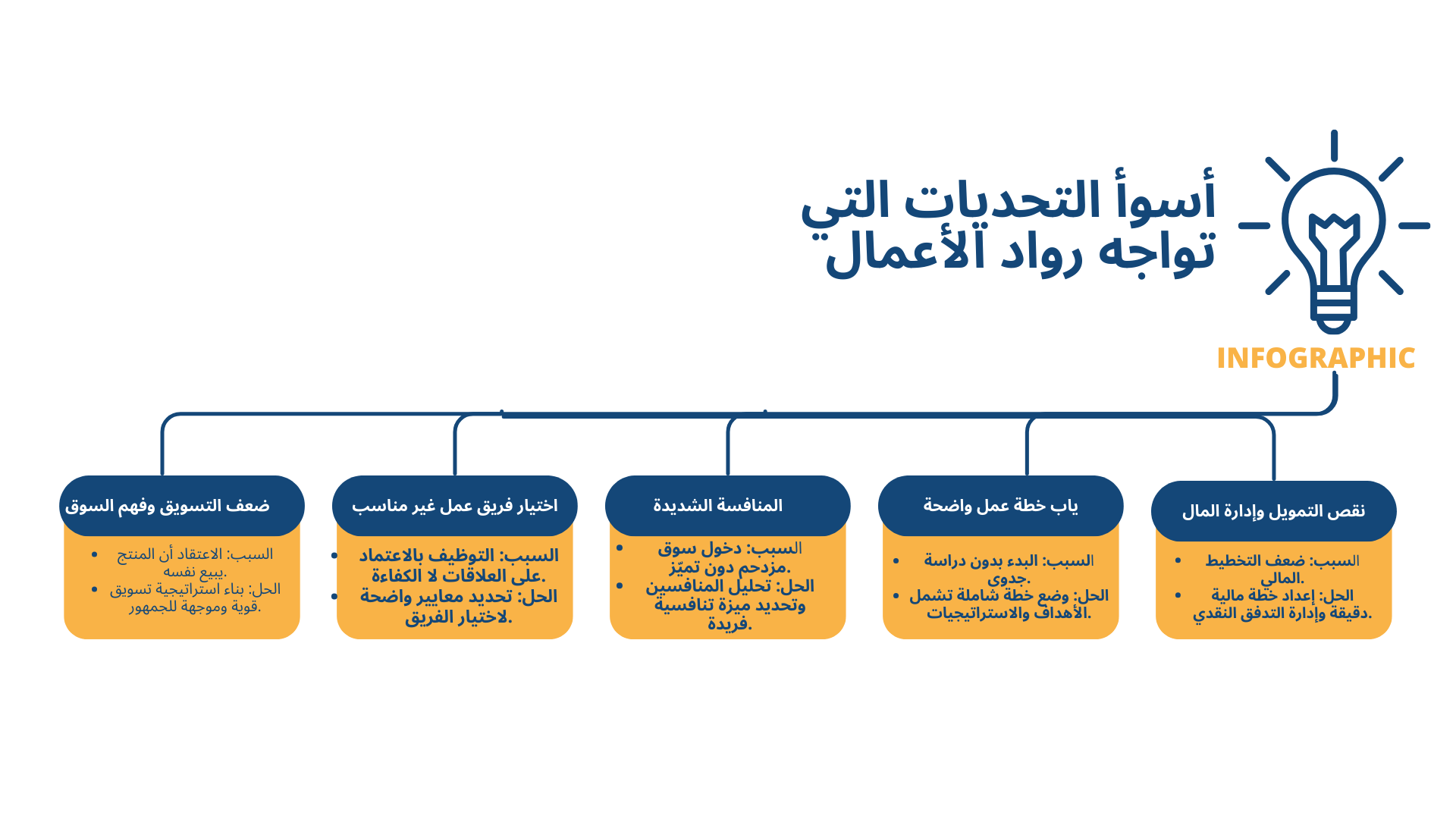
- What is the biggest mistake beginner entrepreneurs make?
The biggest mistake is entering into a project without a clear action plan or a detailed feasibility study, which leaves them vulnerable to surprises and loss of resources. - How can an entrepreneur overcome a lack of funding?
By seeking investors, or starting with a small, scalable business, while strictly managing costs, exploring options like crowdfunding or subsidized loans. - Is it necessary to have a mentor or advisor at the beginning of a project?
Yes, having an experienced mentor makes it easier to avoid common mistakes and provides important practical advice. It also helps open doors to new networks and potential funding opportunities. - Marketing is crucial for project success because it helps to identify and understand the target audience, develop effective strategies to reach them, build brand awareness and customer loyalty, and ultimately drive sales and revenue.
Marketing is the only way to reach target customers and build a fan base, so it cannot be ignored. Without marketing, even the best products can remain unknown. - How can we deal with psychological stress?
By organizing your time, taking regular breaks, talking with supportive people or professionals, and exercising or engaging in recreational activities to recharge your energy.
Conclusion
The road Entrepreneurship Full of difficulties, but also full of opportunities for those who can persevere and learn from mistakes. Novice entrepreneurs face difficult situations that may seem fatal to their projects, yet awareness of them and preparedness to confront them is what transforms them into opportunities for development and growth. Good planning, wise resource management, careful team selection, and flexibility in the face of change are the keys to success. Therefore, challenges should not be a reason to retreat, but rather a motivation to persevere and achieve dreams. Every challenge is a lesson, and every failure is a step towards greater maturity and deeper experience, and whoever realizes this becomes closer to sustainable success.