

 Amidst accelerated climate change and the global trend towards sustainability, Green finance One of the most important economic tools to support environmentally friendly projects. It aims to provide funding sources for initiatives that reduce carbon emissions, rationalize the consumption of natural resources, and support the circular economy.
Preparing a feasibility study for a green finance project is a crucial step to understanding its economic, social, and environmental viability, and to ensuring its financial sustainability.
What is green finance?
Green finance It is a financing mechanism directed towards projects and activities that achieve clear environmental benefits such as:
- Renewable energy projects (solar, wind, green hydrogen).
- Sustainable transportation solutions (electric cars, charging infrastructure).
- Waste Management and Recycling.
- Energy efficiency in buildings and factories.
- Smart and environmentally friendly agricultural projects.
Green finance is not limited to providing loans or investments, but extends to issuing Green bondsmicrofinance for small projects, and public-private partnerships.
Another suggested topic: What is the best company to conduct an economic feasibility study for a project?
The importance of a feasibility study for a green finance project
- Determine market demandUnderstanding the needs of individuals and companies seeking green solutions.
- Environmental Impact AssessmentCalculation of emissions to be reduced or resources to be conserved.
- Cost-Benefit AnalysisChecking the financial feasibility of the project in the short and long term.
- Attracting investorsWhere global investment firms are increasingly favoring projects with an environmental dimension.
- Compliance with legislationMost countries offer incentives for green projects, such as tax exemptions or government subsidies.
Steps to prepare a green finance project feasibility study
- Market study
- Analysis of demand volume for green products and projects.
- Identifying competitors in the green finance sector.
- Studying relevant government legislation and regulations.
- Technical analysis
- Identify the financing mechanism (loans, green bonds, partnerships).
- Selection of target sectors (energy, agriculture, transportation, green buildings).
- Develop a clear operational plan.
Turn your idea into a successful project now!
Project management isn't just about steps, it's a journey that requires tools and specialized support. With our digital products like
Feasibility و Consulting feeYou can guarantee the success of your project with well-thought-out steps.Learn more about our services and benefit from innovative solutions to turn your idea into a real project.
- Financial analysis
- Estimate of capital required.
- Study of available funding sources (banks, investment funds, donor institutions).
- Forecast revenue and profit over time.
- Social and Environmental Analysis
- Estimate the number of jobs expected to be created.
- Determine the percentage of carbon emissions to be reduced.
- Assessing the impact on community health and quality of life.
Estimated Costs and Returns Model
| Item | Estimated Cost (in USD) | Expected Returns (in USD) | Notes |
| Company Formation and Legal Structure | 100,000 | — | Includes registration and licensing |
| Digital infrastructure | 250,000 | — | Online platform for providing financing services |
| Marketing Campaigns | 50,000 | — | Digital Marketing and Ads |
| Project Financing (Working Capital) | 1,000,000 | 1,500,000 | Seed funding for energy and recycling projects |
| Annual returns from financing | — | 500,000 | Profits from interest or profit sharing |
| International Support and Grants | — | 200,000 | Environmental grants from international organizations |
| Total over 3 years | 1,400,000 | 2,200,000 | Estimated net profit: 800,000 |
Potential challenges
- Rising technical infrastructure costs.
- The difficulty of convincing some investors or clients to go green.
- The need for strict compliance with environmental and financial legislation.
- Fluctuations in traditional energy prices that may affect demand.
Opportunities for success
- Increasing government support for green projects.
- Individuals and companies are increasingly aware of the importance of sustainability.
- Availability of international scholarships and concessional financing from development banks.
- The possibility of regional and global expansion with the success of the local model.
Frequently Asked Questions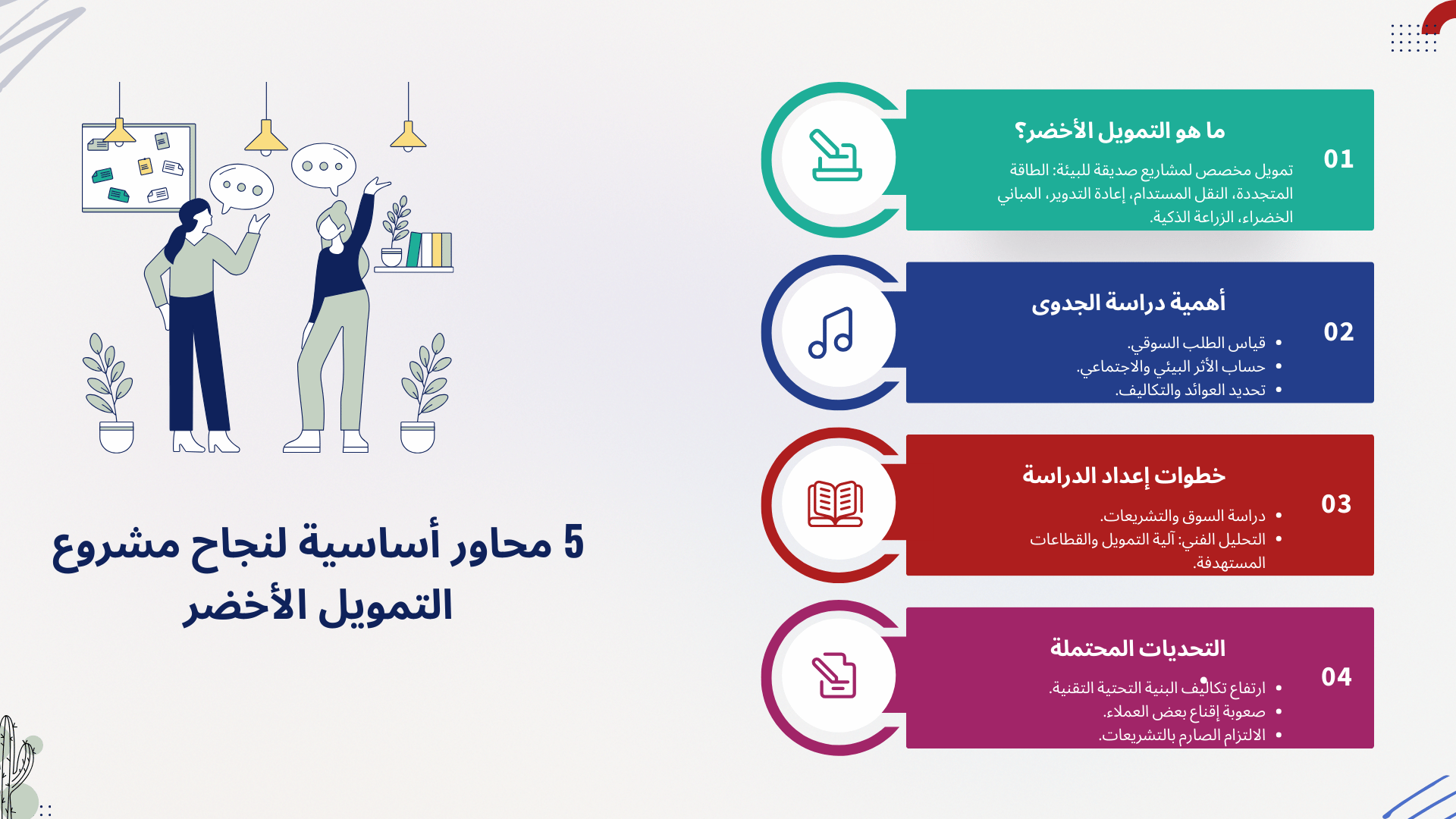
- The difference between green finance and traditional finance lies in their objectives and the types of projects they support. Traditional finance primarily focuses on financial returns, with little to no regard for environmental or social impact. Green finance, on the other hand, specifically aims to fund projects and initiatives that have positive environmental and social benefits, alongside financial returns. These benefits can include reducing greenhouse gas emissions, promoting renewable energy, improving energy efficiency, conserving natural resources, and supporting sustainable development.
Green finance is exclusively allocated to projects that achieve environmental goals, while traditional finance funds any project without regard to environmental impact. - Is green finance profitable for investors?
Yes, it combines financial and environmental returns, and often receives support and incentives that reduce risk. - Which sectors benefit most from green finance?
Renewable energy sector, sustainable transportation, recycling, and green buildings. - Is there real demand for green finance in the Arab world?
Yes, as the region is witnessing strong transformations towards renewable energy and smart city development. - Can the project be small or must it be big?
The project can start as a small foundation to fund local initiatives, or it can expand to become a large investment fund.
Why is “feasibility” your best partner in studying future projects?
In a world where technology is accelerating and artificial intelligence is emerging as an intelligent assistant for decision-makers, it remains “Al-Jawda” Company” in a leading position in providing Smart, accurate, and realistic feasibility studies intermix The power of technology and the wisdom of human experience.
We don't just generate superficial numbers or predictions – we go deeper to understand the market, the local environment, regulations, and the human factors that make the real difference between “a plan on paper” and ”a successful project on the ground.”.
What distinguishes us:
- ✅ Hybrid studies Combines AI analytics with precise consulting expertise.
- ✅ Full customization for every study Depending on the nature of the local market or the funding entity.
- ✅ Interactive dashboardsDashboards) It helps you monitor your project's performance after implementation.
- ✅ Scenario simulation Reality shows you how your project will perform in the best and worst-case scenarios.
- ✅ Fast delivery and deep analysis.We use smart tools to reduce time and increase quality.
- ✅ Integrated team From market experts, financial analysts, and tech experts.
- ✅ Postgraduate supportWe don't leave you at delivery; we follow up with you throughout the implementation and financing stages.
In “Feasibility“We believe that a feasibility study is not just a document – it is a roadmap to a safe, smart, and successful investment.
Conclusion
And Green Finance Project It's not just an economic initiative, but a future vision that balances financial returns with environmental protection. The feasibility study shows that this project is capable of achieving sustainable profits, in addition to strengthening the position of the adopting institution as a key player in sustainable development.
In a world striving to limit climate change and achieve carbon neutrality, investing in green finance is not a luxury, but a strategic necessity for the future.